

Welcome FINTECHTALKERS!
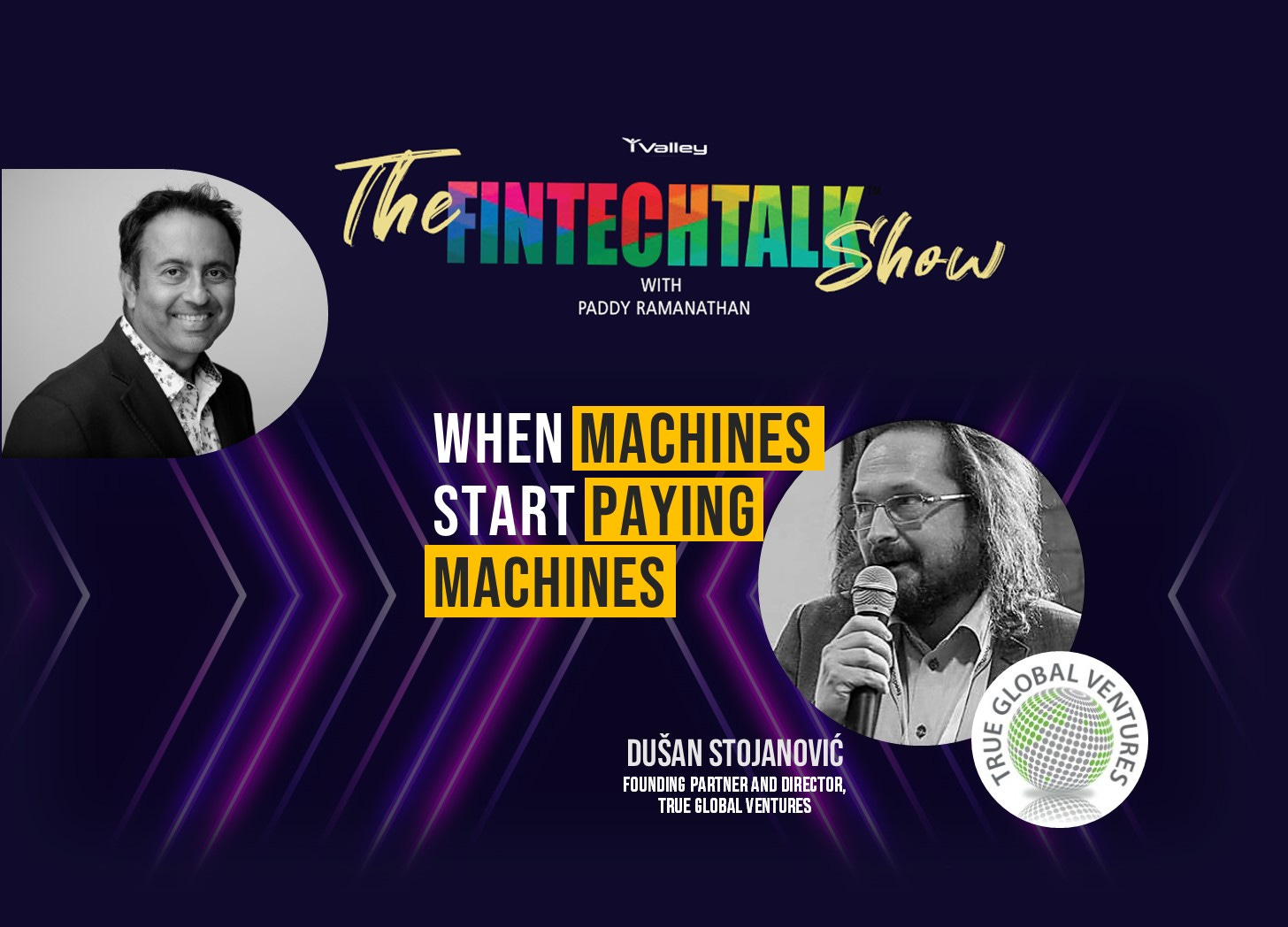
I was able to get a few minutes with Dušan Stojanović, Founding Partner at True Global Ventures (TGV) Plus, as a preview for the upcoming 74th TGV Conference, to unpack a major shift unfolding at the intersection of stablecoins, AI, and financial infrastructure.
FINTECHTALK Perspective: What This Means
Dušan described a new computing and financial stack being built in real time — and at breakneck speed.
SaaS Is the New Mainframe: Models and Agents Take Center Stage
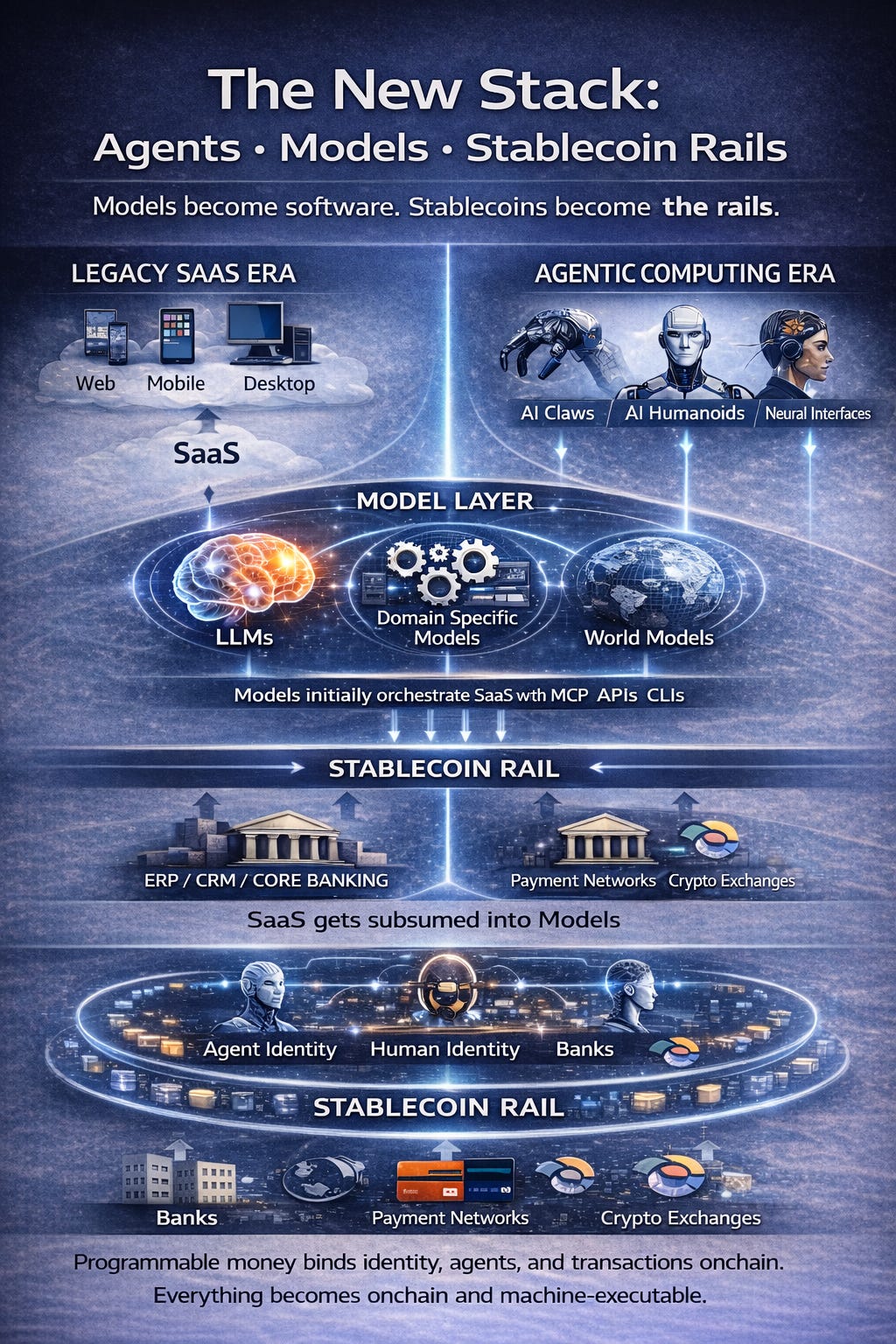
The big shift is this: SaaS is starting to look like legacy infrastructure. In the old world, software applications sat at the center of how work got done. In the next world, models and agents do. SaaS may persist for some time, just as mainframes did in the distributed era, but its role changes. It becomes underlying infrastructure rather than the primary interface for work.
That is the transition this infographic captures — and what Dušan and TGV are helping accelerate through their portfolio.
The UI Is Dead: Agents Become the Interface, Models Hold the Logic and Data
The human-to-AI interface is evolving fast: from software copilots, to agentic “claws” like OpenClaw and NemoClaw, to humanoids, and eventually to neural interfaces. In the near term, models will connect to existing SaaS systems through APIs, MCPs, and CLIs. Over time, more of the business logic now trapped inside apps like CRM, ERP, and workflow software gets absorbed into the model layer itself, with agents invoking capabilities dynamically based on context.
The Emergence of Agentic On-Chain Finance (AOF): The New Financial Layer
But the most important second-order shift may be financial.
Stablecoins are emerging as the native rails for the agentic economy. They are not just a better payment mechanism. They make money programmable, portable, and machine-native. That has deep implications for commerce, trade finance, treasury, and wealth management.
In our short time together, Dušan sketched something much bigger than a new stablecoin regime in Hong Kong. What he was really pointing to was the emergence of Agentic On-Chain Finance (AOF) — where regulated financial rails, programmable money, and autonomous AI systems begin to converge. The AnchorPoint license with Animoca, Standard Chartered, and HKT is one important signal, but the larger story is what happens when money becomes machine-native and agents can prepare, validate, and eventually execute financial actions across trade, cross-border flows, and treasury with far less human intervention.
This is, in many ways, open banking for the agentic era: not just connecting accounts and services, but enabling fintech agents to act on behalf of consumers and businesses using programmable financial rails.
Consider one example: an AI commerce agent handling a $25,000 equipment purchase for a small business. Instead of simply charging a card, the agent could compare options and source the best option, verify identity, compare available payment options, choose between stablecoin settlement, supplier financing, credit, or BNPL based on cost and cash-flow impact, execute the payment instantly, update the firm’s treasury position, and adjust the company’s forward cash plan — all in one flow. The product is no longer just a loan, a payment, or a deposit account. The product is the agent orchestrating the best financial outcome in real time.
The Rise of Agentic Venture Capital
Even venture capital is being rewritten.
As Dušan suggests, the next great VC firms will not just provide capital — they will operate as agentic intelligence platforms, delivering the combined experience, network, pattern recognition, and operating support of the firm to portfolio companies 24/7. In that world, TGV has the potential to be a pioneer in Agentic Venture Capital: a model where the institutional knowledge of the partnership is encoded into domain-specific models and agents that help founders with go-to-market, hiring, partnerships, strategy, and execution at scale.
If you want to understand where fintech — and venture itself — is heading beyond apps, UX, and even embedded finance, this is the conversation.
To learn more, join Dušan, TGV, and their portfolio companies at the 74th TGV Conference this Thursday, April 23, at 3:45 PM PT.
Sign up here for the 74th TGV Conference
🎧 Listen Now to explore how finance is being rebuilt for a world where machines transact.
Timestamp Table
0:00 – 1:30 — Introduction
Paddy introduces Dušan Stojanović and the focus on AI, crypto, and financial infrastructure.
1:31 – 4:30 — Hong Kong’s stablecoin breakthrough
Animoca, Standard Chartered, and Hong Kong Telecom secure one of the first licenses
4:31 – 6:30 — Stablecoins as payment evolution
From early online payments to programmable digital money.
6:31 – 8:30 — Trade finance and automation
How stablecoins can streamline complex trade documentation and settlement.
8:31 – 10:30 — Machine-to-machine payments
What happens when autonomous systems start transacting.
10:31 – 12:30 — Security and human-in-the-loop systems
Why hardware-based solutions like Ledger may anchor trust.
12:31 – 14:30 — AI evolution: from LLMs to agents
The rise of small language models and domain-specific AI systems.
14:31 – 16:00 — The VC transformation
Why venture firms must become AI-enabled networks.
16:01 – End — The bigger shift
“We’re not just digitizing finance—we’re redesigning it for machines.”
FINTECHTALK: A Top 10% Global Podcast Shaping the Future of Fintech, AI, and Crypto and was recently ranked in the Best 100 Future Tech Podcasts by Million Podcasts.


Ranked by ListenNotes
Looking to amplify your brand’s reach? Partner with our podcast and connect with an engaged and loyal audience. Contact us today to explore sponsorship opportunities and elevate your brand! fintechtalk@substack.com
Enjoy and always be in the know,
Paddy Ramanathan
Founder of iValley and Host of the FINTECHTALK™ Show (on Substack, Apple Podcast, YouTube, and Spotify)
Interested in sponsorship opportunities and be associated with sculpting the future? Please reach out to fintechtalk@substack.com.
Thanks to ChatGPT for suggestions.


