

Welcome FINTECHTALKERS!
Embedded finance is still one of the most powerful distribution models in financial services.
But it’s no longer as simple as it once looked.
There was a time when the playbook felt straightforward: add payments, add lending, add a wallet—and you were in the game. Today, that model is breaking down under the weight of compliance friction, weaker economics, shallow integrations, and new AI governance challenges
The result is a more disciplined market.
Embedded finance isn’t fading—it’s maturing. And that maturity is forcing a more important question:
Under what conditions does embedded finance actually work?
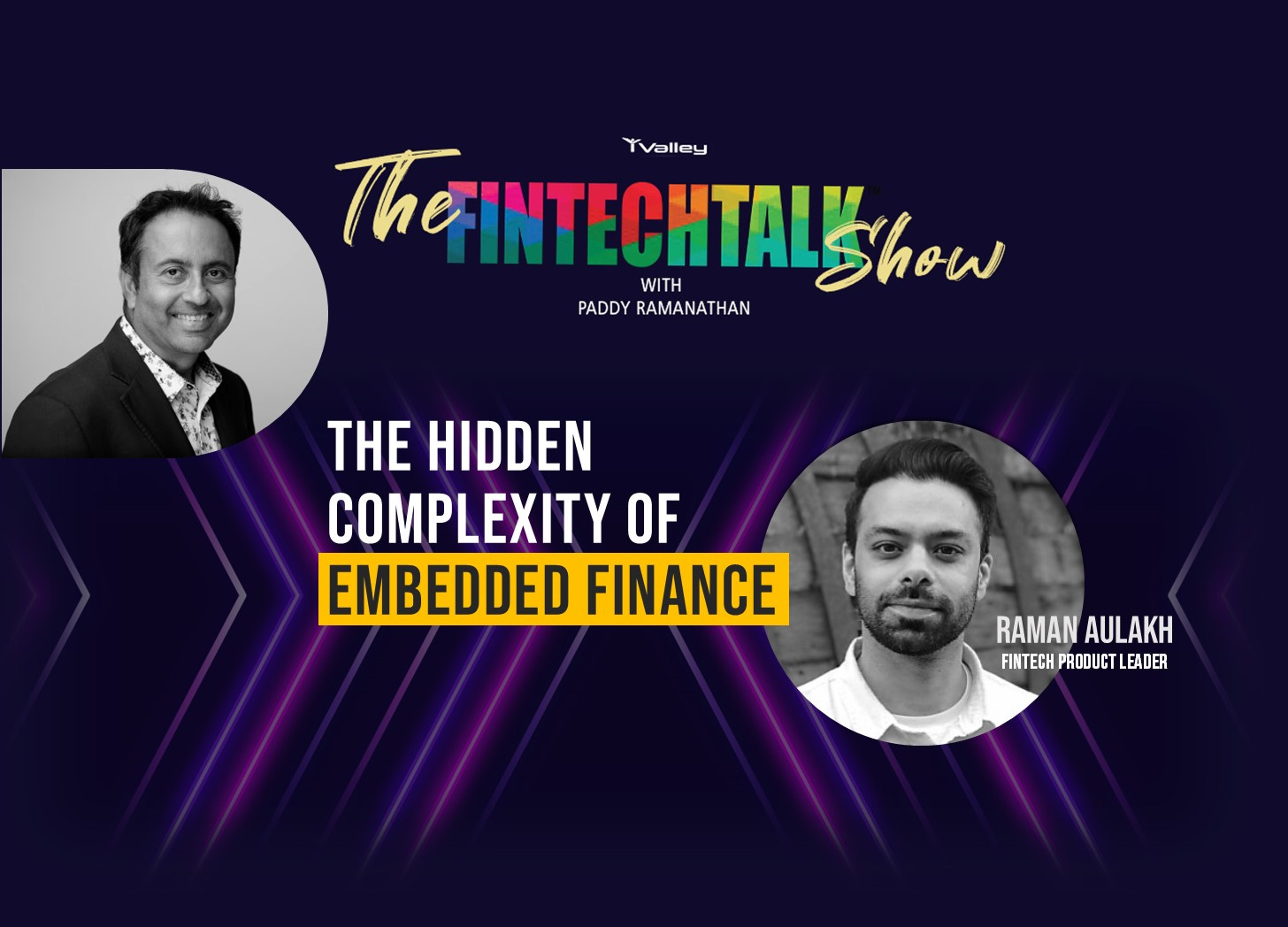
In this episode, I sit down with Raman Aulakh, a fintech expert who has led product teams at Visa, PayPal, Amazon, Yodlee (Envestnet) bringing a deep pulse on both fintech and embedded finance, to unpack a practical five-condition framework for evaluating embedded finance strategy
Raman Aulakh is a FinTech product leader specializing in global payments, bank integrations and AI-powered financial products. Over the past 15 years, he has led cross-functional teams to conceptualize, launch and scale global FinTech platforms. He’s passionate about building products that elevate customer experiences through greater interoperability across the financial services ecosystem.
Rather than looking at embedded finance as a product decision, this conversation reframes it as a structural problem—one that depends on workflow control, data quality, economics, regulatory design, and the intensity of the user problem being solved.
The discussion breaks this down across three critical perspectives:
The endpoint (retailers, vertical SaaS, platforms)
The embedded finance enabler (BNPL providers, orchestration platforms)
The issuer or balance sheet partner (banks and capital providers)
What emerges is a clear takeaway:
Embedded finance doesn’t fail because the idea is wrong.
It fails when the underlying conditions aren’t strong enough to support it.
And as AI enters the stack, that distinction becomes even sharper.
🎧 Listen Now to understand what separates embedded finance that scales from embedded finance that stalls.
Key Takeaways
1. Embedded finance is maturing—not declining
The market is becoming more selective, with higher expectations on structure, economics, and compliance.
2. Workflow ownership is the foundation
Access to users is not enough—platforms must control the transaction moment where financial intent is created.
3. Data density determines decision quality
Without rich, real-time operational data, embedded finance cannot support lending, pricing, or AI-driven decisions effectively.
4. Economics must be real—not assumed
Volume alone doesn’t work. Sustainable programs improve retention, conversion, and overall business value.
5. Regulation is now a design constraint
Compliance, governance, and responsibility allocation are no longer backend concerns—they shape the entire model.
6. AI amplifies structure, not weakness
AI enhances strong embedded finance systems—but cannot fix poor data, weak workflows, or unclear ownership.
Timestamp Table
0:00 – 2:10 — Opening thesis: Embedded finance is maturing
Why the “just add payments” era is over and the market is becoming more disciplined.
2:11 – 5:00 — State of embedded finance today
From easy distribution to higher scrutiny on economics, regulation, and integration.
5:01 – 6:30 — Introducing the five-condition framework
Why the question has shifted from should we do embedded finance to when does it work?
6:31 – 8:50 — Condition 1: Workflow ownership
Why controlling the transaction moment matters more than audience access.
8:51 – 11:20 — Condition 2: Data density
The role of real-time operational data in underwriting, pricing, and AI decisioning.
11:21 – 14:10 — Condition 3: Economic upside
Why embedded finance must create real business value beyond payments volume.
14:11 – 16:30 — Condition 4: Regulatory leverage
How compliance, governance, and role clarity define long-term viability.
16:31 – 18:30 — Condition 5: User pain intensity
Why solving high-frequency, high-impact problems determines adoption and retention.
18:31 – 22:30 — Applying the framework: Endpoints
How platforms should sequence and prioritize embedded finance products.
22:31 – 23:50 — Applying the framework: Enablers
Why partner selection and distribution quality matter more than scale.
23:51 – 25:10 — Applying the framework: Capital providers
How banks and issuers should think about risk, data, and asset quality.
25:11 – End — AI and the future of embedded finance
Why AI shifts the model from embedded products to embedded decisioning.
Want to feature your company in the AI Stack?

https://substack.fintechtalk.ivalley.co/about

Don’t just build the future. Sculpt it.
Contact us at: fintechtalk@substack.com
FINTECHTALK: A Top 10% Global Podcast Shaping the Future of Fintech, AI, and Crypto and was recently ranked in the Best 100 Future Tech Podcasts by Million Podcasts.

Paddy Ramanathan
Founder of iValley and Host of the FINTECHTALK™ Show (on Substack, Apple Podcast, YouTube, and Spotify)
AI assistance: ChatGPT (OpenAI), Gemini (Google), and Sora (OpenAI) supported drafting and creative ideation


