

Welcome FINTECHTALKERS!
For decades, enterprise software has helped companies collect more data, build more dashboards, and generate more reports. Yet one problem has remained stubbornly unsolved: turning information into timely, confident decisions.
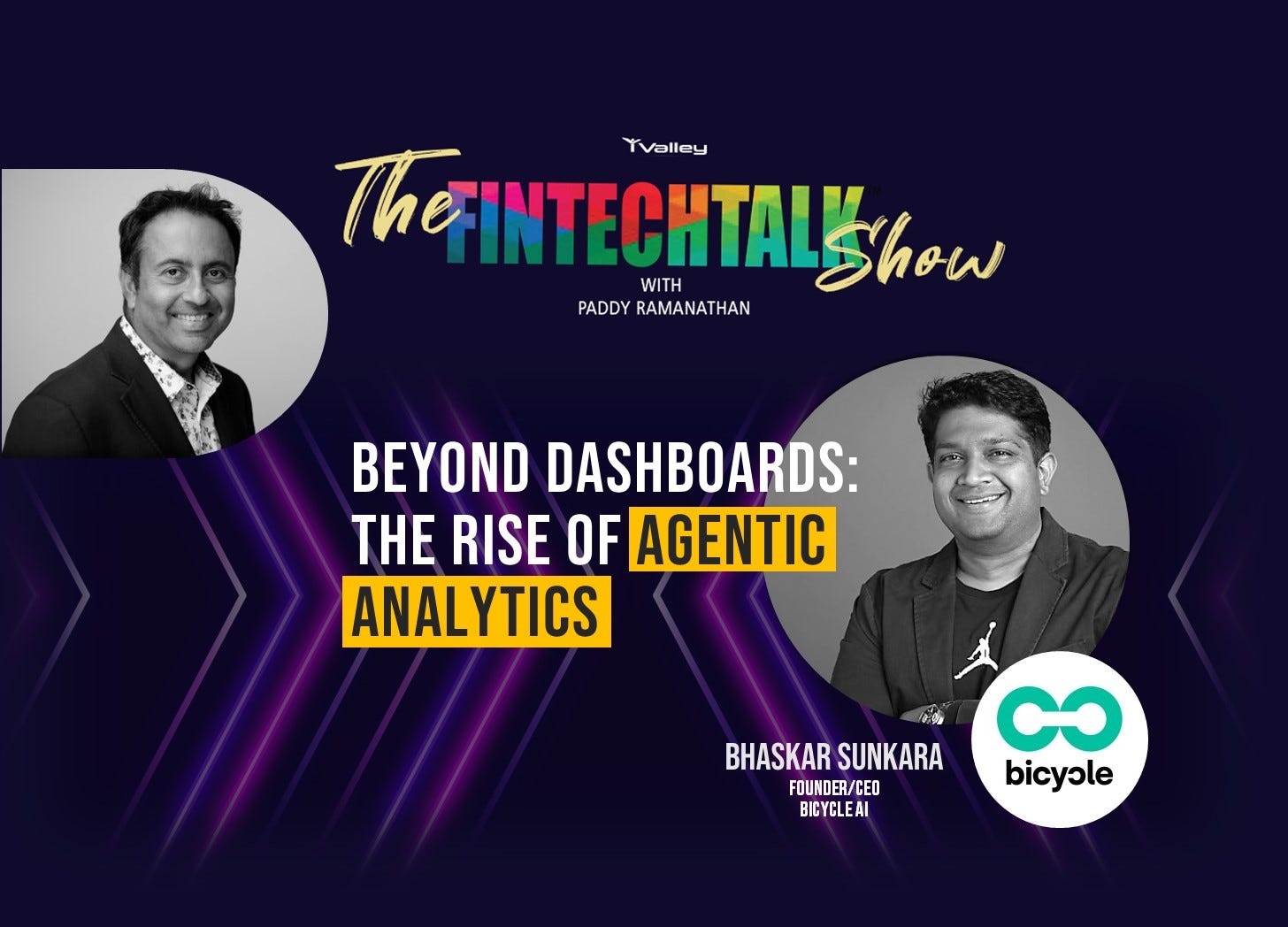
In this episode, I sat down with Bhaskar Sunkara, founding CTO of AppDynamics and now founder of Bicycle AI, about why the next era of enterprise AI isn’t about better analytics—it’s about Enterprise Performance Intelligence.
At FINTECHTALK, we define Enterprise Performance Intelligence (EPI) as an AI-native operating layer that continuously observes business performance, detects meaningful signals, explains why they matter, recommends or executes actions, and learns from outcomes to improve future decisions. Rather than simply reporting what happened, Enterprise Performance Intelligence enables organizations to optimize how the business operates in real time.
Bhaskar helped pioneer application observability at AppDynamics, transforming software from a black box into something businesses could measure and optimize. Today, he’s tackling an even bigger challenge: making the business itself observable.
Bhaskar's Bicycle AI is helping define a new enterprise software category: Enterprise Performance Intelligence. Rather than simply giving organizations better visibility into what has happened, Bicycle AI enables businesses to continuously understand what is happening, why it is happening, what actions should be taken, and how to improve future outcomes. By combining AI, business context, and closed-loop learning, Bicycle AI is moving enterprises beyond dashboards and observability toward intelligent, increasingly autonomous decision-making. In doing so, it is helping establish Enterprise Performance Intelligence as the next evolution of enterprise software.
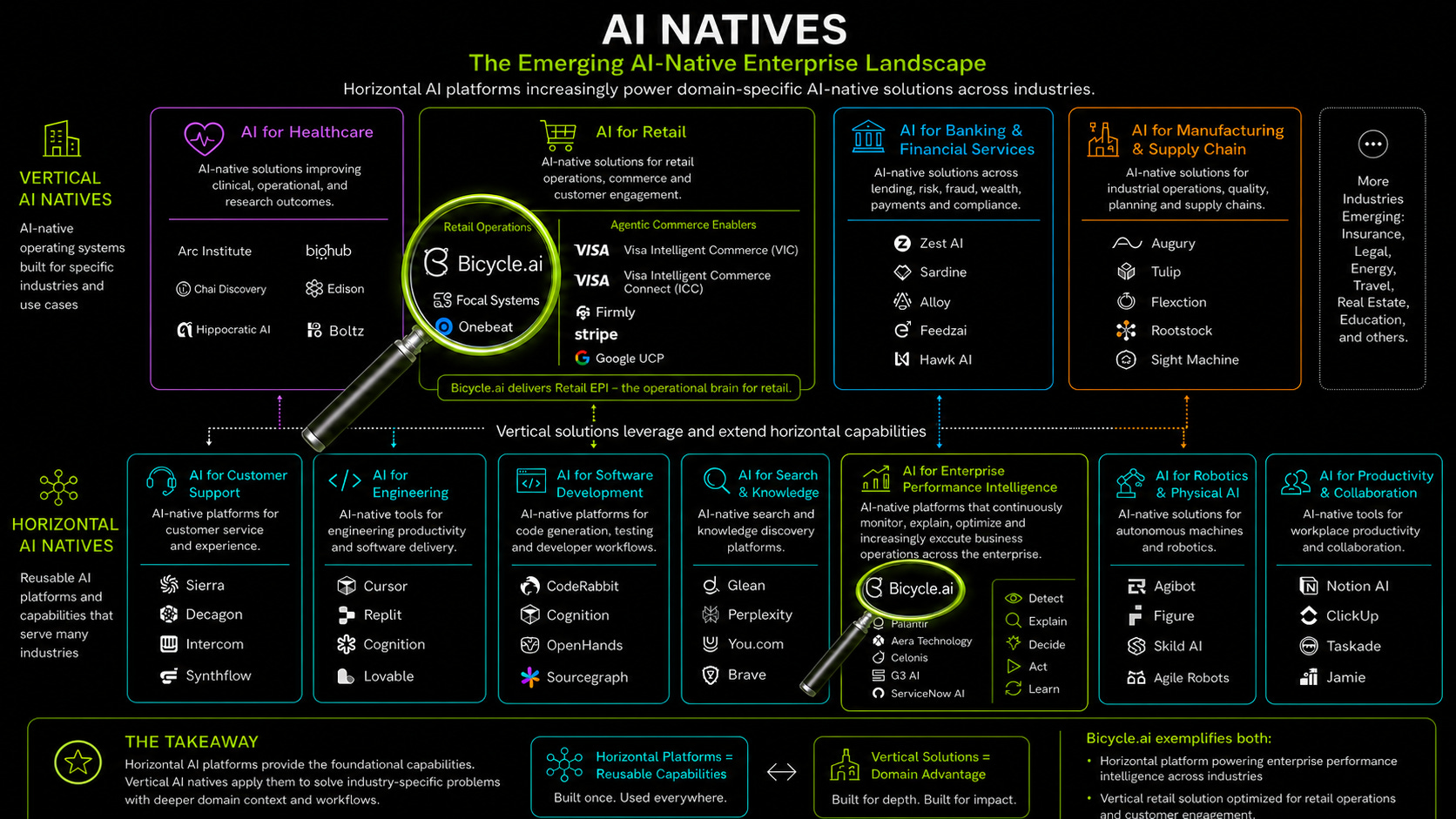
The accompanying AI Natives infographic places EPI within a broader shift in enterprise software. Horizontal AI-native platforms provide reusable capabilities across industries, while vertical AI-native solutions apply deeper industry context to specific business problems. Bicycle AI sits at the intersection of both: it provides a horizontal performance-intelligence capability while applying vertical knowledge to areas such as retail operations and agentic commerce. It is a useful example of how the next generation of enterprise software may combine reusable AI foundations with industry-specific context and workflows.
Bhaskar helped pioneer application observability at AppDynamics, transforming software from a black box into something businesses could measure and optimize. Today, he’s tackling an even bigger challenge: making the business itself observable.
Bicycle AI is helping define Enterprise Performance Intelligence as a new enterprise software category. It enables businesses to continuously understand what is happening, why it is happening, what actions should be taken, and how outcomes can be improved. By combining AI, business context, and closed-loop learning, Bicycle is moving enterprises beyond passive dashboards toward intelligent and increasingly autonomous decision-making.
Bicycle has also made its capabilities more accessible through self-service tools. Teams can now start for free, connect Bicycle to their existing data environment, and build an initial analytics agent around a business-critical KPI—with no credit card required. Learn more or get started at Bicycle.ai.
The conversation also explores why semantic layers are becoming essential for enterprise AI, why generic large language models aren’t enough to understand business context, and how retail, travel, and payments are evolving as agentic commerce reshapes customer journeys.
If you’ve wondered what enterprise AI will look like after chatbots and copilots, this episode offers one of the clearest visions yet.
🎧 Listen Now to discover why the future of enterprise software isn’t more dashboards—it’s systems that continuously help businesses make better decisions.
Key Takeaways
1. Dashboards don’t make decisions
The real bottleneck isn’t data—it’s turning signals into action.
2. Enterprise AI needs business context
LLMs alone can’t understand KPIs, workflows, policies, or operational nuance.
3. Agentic Analytics goes beyond copilots
Instead of answering questions, AI continuously detects, explains, recommends, and learns.
4. Semantic layers are becoming critical infrastructure
Understanding the business is as important as understanding the data.
5. Retail, travel and payments are becoming AI-native
As commerce fragments across AI agents, merchants need real-time operational intelligence.
6. The future belongs to vertical AI
General AI answers questions. Vertical AI knows which questions matter.
Timestamps
00:00 – 01:50 — Introduction: From AppDynamics to Bicycle AI
01:51 – 06:30 — Why enterprise observability evolved into business observability
06:31 – 11:30 — Why dashboards aren’t enough anymore
11:31 – 18:20 — What “Agentic Analytics” actually means
18:21 – 23:10 — The DEAL framework: Detect, Explain, Act, Learn
23:11 – 28:30 — Why Bicycle focuses on retail, travel and payments
28:31 – 35:10 — Semantic layers, ontology, and teaching AI how a business works
35:11 – 42:40 — Building enterprise AI that understands context—not just data
42:41 – 53:45 — Agentic commerce and how AI is reshaping retail operations
53:46 – 59:40 — Why vertical AI beats generic AI for enterprise decision-making
59:41 – End — The future of enterprise software: autonomous operations with humans providing strategy, judgment and accountability


Ranked by ListenNotes
Looking to amplify your brand’s reach? Partner with our podcast and connect with an engaged and loyal audience. Contact us today to explore sponsorship opportunities and elevate your brand! fintechtalk@substack.com
Enjoy and always be in the know,
Paddy Ramanathan
Founder of iValley and Host of the FINTECHTALK™ Show (on Substack, Apple Podcast, YouTube, and Spotify)
Interested in sponsorship opportunities and be associated with sculpting the future? Please reach out to fintechtalk@substack.com.
Thanks to ChatGPT for suggestions.


